The best thing I've ever written, probably
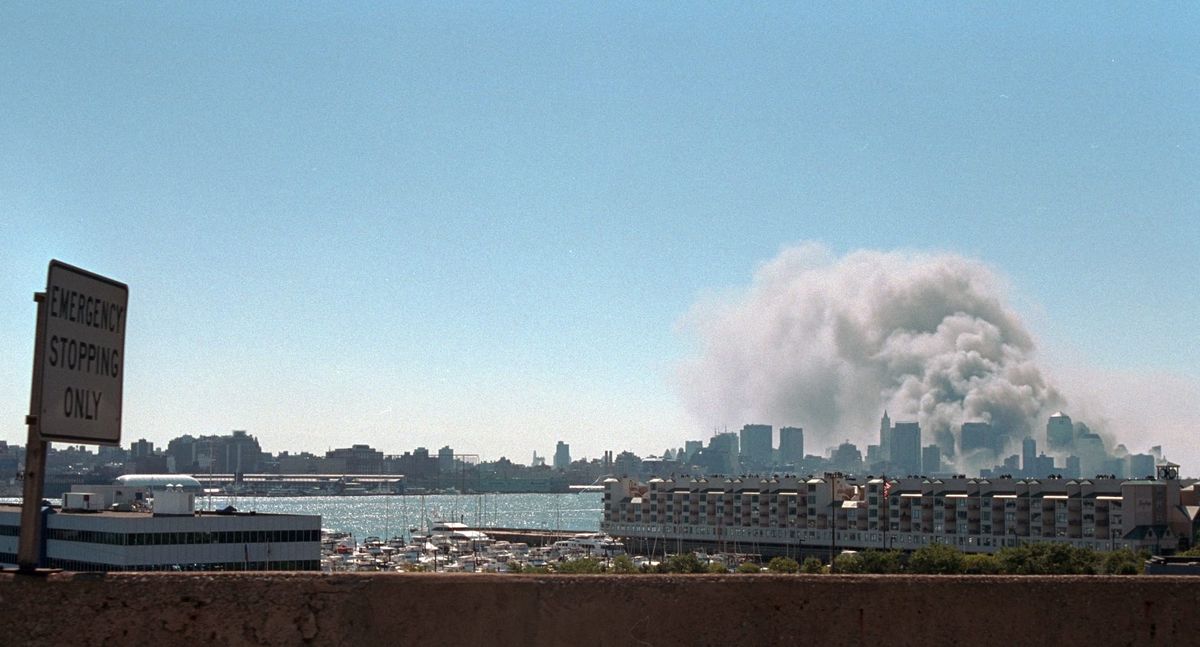
On the 25th anniversary of 9/11, I wanted to revisit my initial reaction to the tragedy.
At the time, I was working as a national sports editor and columnist for Internet Broadcasting Systems, a dot-com pioneer that built and populated news websites for TV stations. Moments after the second plane hit the World Trade Center, all hands were called on deck and we spent the next week basically fully staffed around the clock to post updates on the carnage. I was pulled off my normal beat — there wasn't any sports to cover anyway — and moved to the night shift to monitor the wires and video feeds rolling into the newsroom.
Six days after the terrorist attacks on the World Trade Center and the Pentagon, I finally found the time and the voice to register my reactions to the events. The piece was titled "This Changes Everything" and it remains the one piece of writing I refer back to on days when I wonder if I can write. Yes, I'm proud of this essay in three parts, and since it's pretty much lost to the Internet void, I'm taking this opportunity to post it here.
Re-reading it with the perspective of 25 years of history behind us, it amazes me how dead-on some of my observations were, especially for a guy who didn't really follow politics that closely at the time. But it also saddens me that my guarded optimism pretty much immediately bogged down in the quagmire of Iraq. At least said optimism was guarded.
Each piece came with the following intro/disclaimer/psychic infodump:
Editor's note: As much as we want to return to the lives we led before Sept. 11, 2001, we have to come to grips with this cold, hard fact: Our lives will never be the same.
Ever since that bloody, brutal day, my mind has been spinning. I've been too choked with rage to even put this barrage of thoughts, hopes and fears into one coherent, cohesive message. So here they are, loosely organized into three themes. Make of them what you will.
A tad dramatic, perhaps? Well, you had to be there.
Anyway, once again, here are the thoughts that were spinning through my mind six days after 9/11. And once again, make of them what you will.
Part I: Innocence Lost & Found
My daughter is 3½. She goes to preschool at a local Catholic college, an oasis of enlightenment in a serene corner of our capital city.
The school is designated as a "peace site." Fighting is not allowed at her preschool. Angry words and children's spats are quickly and calmly resolved by the wonderful teaching staff. Parents are encouraged to refrain from dressing kids in superhero costumes at Halloween, or sending them to school with G.I. Joe lunch boxes — because even superheroes and soldiers have to use fists and guns to solve their problems.
I always found it somewhat quaint, even a bit unrealistic — a "peace site" in a world where peace has become an abstract concept, a buzzword. Now I realize that we need peace sites more than ever.
Since Tuesday, my wife and I have discussed peace with our daughter. We've tried to explain, in the most general of terms, why we were praying for people in New York and Washington, why we were praying for peace, and why bad guys sometimes hurt good people.
Thursday night, while I was back at work for another long night of reporting on the horror that was gripping the world, my wife tucked in our daughter, said those prayers again, and kissed her good-night.
But a few minutes later, she padded across her bedroom, quietly stole into our home office, and saw something surprising on the computer over her mother's shoulder.
"Mommy, what happened to that building?"
Horrified, my wife realized that she had to put the situation into more concrete terms for her curious little mind, so she explained a bit more about what those bad guys had done, that we were safe, but many people had been hurt.
Later that night after I got home, exhausted but too tired to sleep, we lay in bed talking about the tragedy and wondering how a little girl would deal with this disaster that we couldn't even get our own worldly minds around. I fully expected to be on Nightmare Patrol at some point before morning.
Instead, I was greeted at sunrise with evidence of the resiliency of children. My beautiful daughter padded back across her bedroom floor and hopped into our bed. She gently tugged on my nose, which is our little wakeup game each morning. And she said the most important words I've heard in a week.
"Daddy, I saw the building that got hit by the plane last night. And you know what? The bad guy who did that forgot to be peaceful."
*****
I still can't decide whether I'm more horrified by what has happened, or afraid of what's yet to come.
*****
I went to the grocery store Saturday. A disabled vet was stationed outside the front door, handing out flowers as a reminder of those who served to keep our nation free.
As I was digging out my buck for his tin can, I heard the vet talking with another 50-something guy. One of them said, "I wonder if these kids have it in them to fight."
And I thought to myself, "You're damn right they do."
I'm 33 years old. My generation hasn't had to live in wartime. We were babies during Vietnam, and as far as we knew the Gulf War was a four-day CNN miniseries.
We were the first generation raised in a society that not only permitted, but actually encouraged us to question our government. Our parents are as likely to be draft dodgers or protesters as combat veterans. How do you think that affected our collective psyche?
We like our movies, our sports, our computers, our conveniences. Call us soft if you will – it's the byproduct of world peace. Now that peace has been threatened, and it's our turn to answer the call.
I can understand their skepticism – I really can. But The Greatest Generation had WWII as their proving ground. Here's ours.
*****
All day Tuesday, as the TV kept showing replays of those planes bearing down on the Twin Towers, the wreckage at the Pentagon, the smoldering pit in the Pennsylvania countryside, I couldn't get one thought out of my mind.
This is like a bad Tom Clancy novel. But there's no Jack Ryan to step in and save the day.
*****
I have family in Northern Ireland. They have to live with this every day of their lives. Not the deaths of 5,000 countrymen (editor's note: the final, accepted total of around 3,000 victims wasn't arrived at for a few weeks — early on, IIRC, the number 10,000 was bandied about by authorities) and a direct attack on their government, but the unsettling notion that at any moment, their lives could be forever changed just by walking out the door, starting the car, or walking down the wrong street at the wrong time.
I've visited my relatives twice, and each time I've marveled at how they speak of violence and terrorism as a matter of fact, like the weather. It's part of their everyday lives, and yet they carry on.
I don't want to live like that. But I'm afraid I might not have a choice.
Part II: The Ugly American
Some of you out there still wonder why they would commit such a heinous act, why they hate us so much.
Not to ignore the complex political and religious issues, but in its condensed form, they hate us because we are the haves, they are the have-nots, and we have no problem waving it in their faces.
Of course, our success is the fruit of our labor, or our ancestors' labor. (Ed: phew, the naiveté is totally cringe.) We've earned the right to be proud of our country's accomplishments. But we haven't earned the right to be so arrogant about it.
The term "Ugly American" was not coined by Osama bin Laden or Saddam Hussein or the Ayatollah Khomeni. Even our allies, our international best buddies, call us Ugly Americans when we complain in an English pub that we can't get a Miller Lite, when we expect the rest of the world to speak our language, when we overrun a country to protect our oil interests, when another McDonald's pops up in Moscow, a KFC in Belfast, a Pizza Hut in Paris.
Our vanity, our materialism, our expectation that the world will adapt to our culture – they all make us jokes in some international circles, bullies in others, and targets in still others.
Now, before you get all riled up and start sending me that Gordon Sinclair essay on Americans (written nearly 30 years ago, by the way), I'm fully aware of how we've helped other countries and asked for nothing in return, how we bailed out the world in two big wars, how we are the best and the brightest the planet has to offer.
I believe all that. I am damn proud to be an American. I love it, and I'm not gonna leave it.
But somebody is trying awful hard to send us a message. It's too simple to just write this tragedy off as the isolated act of one psychopath with a fanatical following.
Of course, this particular psychopath picked the wrong country to tangle with. Deep down, I'm confident that he'll live to regret taking on the United States of America. And then he'll die regretting it.
But when this whole nightmare is over, when the forces of evil have been soundly defeated and a new day has dawned, that international perception of the Ugly American will still be there. And we'll be left to ask ourselves if we want to do anything about it.
*****
On Wednesday I read a great column on ESPN.com by baseball writer Jayson Stark about players' reactions to the tragedy. Stark said he got an e-mail from Dodgers pitcher Terry Mulholland asking him to use his influence to "urge the many healthy, able-bodied athletes in our country to immediately and unselfishly donate blood to their local blood banks."
That's great. Athletes should chip in at the blood bank, just like the rest of us. But pro athletes also have an inordinate amount of one resource that the rest of us don't — money. I'm sure Joe Fan would love to dig into his wallet and give 'til it hurts, but after you take out the price of tickets, parking, concessions and souvenirs that accumulate throughout a given season, that's a pretty big dent in Joe Fan's wallet.
Of course, that money goes to pay $252 million to a shortstop, $80 million to a wide receiver, or $2.3 million to a left-handed relief pitcher.
You often (always) hear the latest superstar signing a big-bucks contract say, "It's not about the money." Well, I want to see pro athletes finally put their money where their mouths are.
A-Rod — write a check for $2 million to the Red Cross. Randy Moss, surely you've got a spare million around to help out the relief effort. Mulholland, how 'bout you drop off a check for a hundred grand with that pint of blood?
And don't stage any of these so-called "benefit games" and think that clears your conscience, because you know where that money comes from — that's right, from Joe Fan's dented wallet.
Part III: Moving On – Baby Steps
I've heard plenty of talk about how this tragedy will serve as a unifying factor in our country, how it will bring us together to serve a common purpose and defeat a common enemy.
But a little voice in the back of my head is telling me not to buy it just yet.
I mean, it's easy for people to pull together in a time of crisis, to pitch in and help your neighbor, to embrace a stranger, to fly an American flag and call yourself a patriot.
But what happens a week from now? Two weeks? Two months? Will we fall back into our old patterns as the around-the-clock coverage of the Attack On America becomes an update on the nightly news and a three-hour wait at the airport?
Will you still love me tomorrow?
I don't think I want to find out. Because as a country, we're just not used to loving each other. Since the fall of the Soviet Union more than a decade ago, we haven't had a common enemy, somebody to hate, somebody to fear, somebody to be the butt of our jokes.
So we've looked inward and found plenty of enemies within our own borders. The battlegrounds have been race and gender and politics and sexual orientation. The rhetoric surrounding the O.J. Simpson murder trial displayed a frightening rift between black and white Americans. Rush Limbaugh's daily three hours of liberal-bashing has polarized the right wing, while out-of-touch lefties (Ed: caution, more cringe ahead) like the PETA and NORML crowds give conservatives plenty of ammunition.
Think about the conflicts our country has produced in the last 10 years — Rodney King, the NRA, don't-ask-don't-tell, Monica Lewinsky, gang violence, Tailhook, gay rights, Elian Gonzalez, and dangling chads, just to name a few.
You think we're just going to chuck them all aside, link arms and sing "God Bless America" as we send our brothers, sisters, sons and daughters off to rid the world of terrorism?
I hope that little voice in the back of my head is wrong. I hope we do pull together, just like that. But I'm also afraid that after a decade of battling with each other, we might have a hard time putting our internal struggles behind us as we try to finally stare down a common foe.
*****
I'm a sports guy. I'm supposed to be worried about sports right now. Instead, I'm worried about some of my fellow Americans' reactions to a week without sports.
I've had my fill of talk about "not giving into the terrorists" and the importance of playing our games, even as some 5,000 bodies lie beneath the rubble of the World Trade Center.
Do you really think Osama bin Laden is sitting in his bunker in Afghanistan, cackling to his posse that he prevented the Steelers and Browns from kicking off Sunday night? Would those people be any less dead if Tennessee and Florida had played Saturday?
Postponing the games was such a no-brainer. The country needed time to grieve, reflect and recover — all of us, including athletes. Lest we forget, they're human beings too.
I know that we all grieve differently, and that sports can be a welcome distraction from our troubles. But if you can't see why it would be nothing short of crass to play games a mere four days after CNN was showing footage of people forced to choose between burning alive or tumbling 100 stories to their deaths, I can't help you. We speak a different language.
*****
People, this is a wake-up call like no other.
I don't claim to know where we go from here. Clearly we've got to lick our wounds, circle the wagons, and find a way to cut out the hearts of these bloodless terrorists. And we will.
But in the meantime, the best way I can think of to honor our fallen brothers and sisters is to do what they would love to have one more chance to do — spend time with loved ones.
Put down your cell phone — is that call (Ed: remember when cell phones were used to make calls, and nothing else?) more important than the people in the room with you? Slow down. Reflect on your life. Leave the world better than you found it. Take baby steps toward normalcy.
And don't forget to be peaceful.